PATTERN COLLECTION
Textures to Dye For
7 small needlepoint squares that let you explore texture, colour and the magic of over-dyed threads
AT A GLANCE
When Texture Changes Everything
There’s a moment in needlepoint when something shifts. You move beyond flat, even stitching and start to feel the surface of your work — the raised bump of a Rhodes stitch, the satisfying crunch of a Smyrna cross, the way light catches a diamond eyelet. Suddenly your canvas isn’t just covered. It’s alive.
That moment is what these patterns are about.
I designed the Textures to Dye For collection for my full-day needlepoint workshops. By the afternoon, students who had started the morning feeling tentative were deep in their stitching, watching textures build and thread colours shift across the surface.
Most came close to finishing a design in a single day and completed it at home before the next session. Each square became uniquely theirs — not because they followed different instructions, but because they made different choices about colour and thread.
BEFORE YOU DOWNLOAD
What to Expect From These Needlepoint Patterns
What’s included in each chart?
Every pattern comes as a downloadable PDF with a full-colour chart, stitch placement diagram, written instructions, and a sheet of stitch diagrams showing you exactly how to work each stitch used in the design. You get everything you need to work the piece — no hunting through books or websites for individual stitch directions.
What skill level do I need?
If you can work a basic tent stitch and you’re comfortable counting threads on canvas, you have enough skill to start any design here. Some stitches will be new to you — that’s the whole point.
The instructions walk you through each one, and because the squares are small, you’ll pick things up quickly without a huge time commitment. If a stitch doesn’t go right first time, you’ve only got a few to unpick. No drama.
What fabric and threads should I use?
Most of the samples were stitched on 14-count Aida, with one on 28-count evenweave. Aida is a lovely starting point — the grid is clear, the holes are easy to see, and you can get straight to enjoying the stitches without wrestling with your fabric.
But these designs will work on whatever count of fabric or canvas you like. Finer fabric gives a smaller, more delicate result; coarser fabric gives a bolder, chunkier piece. The key is picking thread or yarn that’s the right thickness for your fabric count, so you get good coverage without forcing stitches through too-small holes.
For threads, this is where the magic happens — over-dyed and hand-dyed threads like Oliver Twists bring textural stitches to life in ways that solid colours can’t. The colour variation in the thread emphasises each stitch’s unique shape and texture. That said, any combination of threads you enjoy will work. Part of the joy is choosing your own palette and seeing what happens.
How big are the finished pieces?
Each design stitches to approximately 3.6 inches (9 cm) square — the perfect size for a pincushion, needlebook cover, coaster, or one panel of a larger cushion. Small enough to finish in a few satisfying sessions, beautiful enough to display or give as a gift.
How long does each design take to stitch?
In my full-day workshops (10 am to 4 pm, with a break for lunch), most students came close to finishing one design and completed it at home before the next session. So you’re looking at roughly a day’s stitching — possibly spread over a few evening sessions if that’s more your style. The more complex designs like Hope, with its nine different stitches, may take a little longer as you get to grips with new techniques.
What makes these “Textures to Dye For”?
The name captures two things: the rich, tactile textures created by combining multiple stitch types in each design, and the stunning effects you get when over-dyed threads travel through different stitches.
A variegated thread looks completely different in a smooth tent stitch border than it does in a raised Rhodes centre — the colour pools and shifts in ways that are genuinely unpredictable, and completely unique to your piece.
BEST VALUE
Get the Complete Collection
All seven patterns in one download — save £3.75
Instant PDF download • All 7 charts with full stitch instructions
THE COLLECTION
Meet the Designs
Each pattern combines multiple stitch types to create a small square rich with texture. Here’s what makes each one different — and which might be the right starting point for you.

Starweavers Delight
Best for: organic texturesThe fan and leaf stitches give this design a flowing, natural quality that sets it apart from the more geometric squares. Light plays across the surface differently depending on your thread choices — shiny threads make the fans shimmer, while matte cotton keeps things subtle.
Stitches: cross stitch, Smyrna cross, slanted gobelin, Rhodes stitch, fan stitch, leaf stitch
Download — £2.25
Serendipity
Best for: geometric texture playStructured blocks of alternating Scotch stitch and cushion stitch create a satisfying grid pattern, while raised Rhodes stitches add pops of dimension. This is a lovely one if you enjoy the rhythm of repetitive stitching with just enough variety to keep things interesting.
Stitches: oblong cross stitch, Smyrna cross, tent stitch, alternating Scotch stitch, cushion stitch, Rhodes stitch
Download — £2.25
Symmetry
Best for: eyelets and decorative effectsThis is the one that makes people lean in for a closer look. The diamond eyelets create tiny light-catching holes in the surface, while the rococo (queen) stitches add an almost lacy quality. Elegant and detailed — a little more intricate than some of the other designs, but the results are worth the extra attention.
Stitches: cross stitch (two sizes), mosaic stitch, rococo (queen) stitch, slanted gobelin, diamond eyelets, Rhodes stitch, tent stitch
Download — £2.25
Tranquility
Best for: layered, tactile richnessRice stitch and crossed corners give this design a wonderfully layered quality — you can feel the depth even before you see it. Workshop students have described their finished pieces as everything from a formal knot garden to sheaves of wheat in a field, depending on their thread and colour choices. That’s the beauty of it.
Stitches: cross stitch (two sizes), slanted gobelin, diamond eyelets, Rhodes stitch, rice stitch, crossed corners stitch
Download — £2.25
Infinity
Best for: bold contrastsClean lines and confident shapes make Infinity one of the most striking designs in the collection. The alternating Scotch stitch creates strong geometric structure, while the Smyrnas and Rhodes stitches break up the surface with raised accents.
It responds beautifully to dramatic thread choices — one student used shiny rayon alongside matte cotton for a result that was, honestly, stunning.
Stitches: cross stitch (two sizes), Smyrna cross, slanted gobelin, alternating Scotch stitch, Rhodes stitch
Download — £2.25
Integrity
Best for: seeing how arrangement changes everythingIntegrity uses the same stitch family as Infinity but arranges them differently — and the effect is surprisingly distinct. It’s a brilliant companion piece if you want to see how layout and proportion change the feel of a design, even when the stitches stay the same. Stitch both, choose different threads, and you’ll have two pieces that look nothing alike.
Stitches: cross stitch (two sizes), Smyrna cross, slanted gobelin, alternating Scotch stitch, Rhodes stitch
Download — £2.25
Hope
Best for: the biggest stitch adventureWith nine different stitches packed into one small square, Hope is the most complex design in the collection — and the most rewarding to finish. The Rhodes heart at the centre is a beautiful focal point, while the Amadeus stitch adds an unusual texture you won’t find in many patterns.
If you want to stretch your skills and try something you haven’t stitched before, this is the one.
Stitches: Rhodes diamond, mosaic stitch, cashmere stitch, alternating Scotch, tent stitch, Smyrna cross, cross stitch, Rhodes heart, Amadeus stitch
Download — £2.25FROM THE WORKSHOPS
Same Pattern, Different Choices, Completely Different Results
One of the things I love most about these designs is what happens when different stitchers bring their own taste to them. In my workshops, everyone starts with the same chart — and nobody finishes with the same piece.
in a single workshop session
have ever looked the same
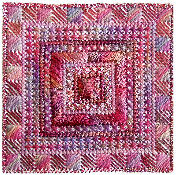
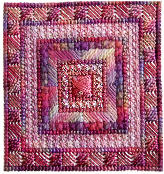
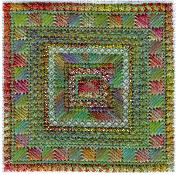
Three students, one Infinity chart — three completely different results
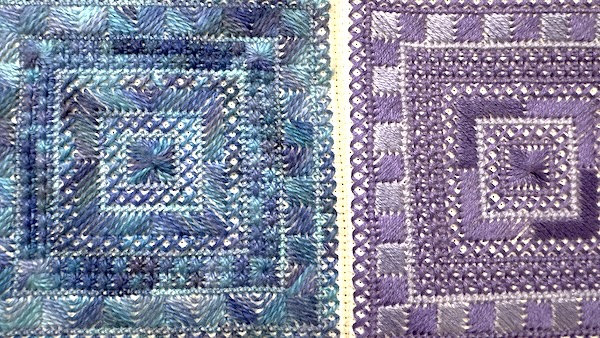
“Anne chose shiny rayon alternating with matte cotton in the Scotch stitch borders. The contrast was gorgeous.”
“Jean stitched her Tranquility in shiny golden threads with matte greens — it reminded everyone of sheaves of wheat.”
Alison used a chunky thread for the wider cross stitch rows and a delicate cotton for the Smyrna stitches, creating a frame-within-a-frame effect that wasn’t in my design at all — she invented it with her thread choices. Margaret went for greens and autumnal tones with metallic thread on the borders. Erica who bought the Hope pattern online, took it in a completely different direction with a monochromatic cream and brown palette, using the contrast between plain and variegated threads to make the corner details sing.
The point isn’t that these students were especially skilled (though they were lovely stitchers). It’s that the designs are built to respond to your choices. Whatever threads you pick, whatever colours call to you — the textures will do the rest.
See the full student gallery and learn how thread choice transforms these designs →
THREAD GUIDE
How Over-dyed Threads Behave in Textured Stitches
The same thread, two completely different effects
Here’s something that surprises people in workshops: take a single over-dyed thread and work it in tent stitch, then work the same thread in a Rhodes stitch right next to it. They won’t look like the same thread.
In the flat tent stitches, the colour changes gradually — a gentle drift from one shade to the next. But in the Rhodes stitch, where the thread wraps and layers over itself, the colours pool and concentrate. You get pockets of intense colour next to lighter areas, and the raised surface catches light differently on every side. It’s genuinely unpredictable, and that’s what makes it exciting.
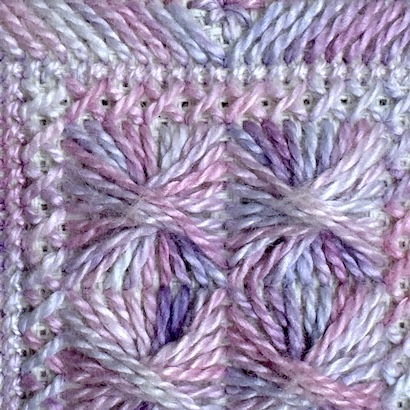
Why over-dyed threads and textured stitches are such a good match
With solid-colour threads, a Rhodes stitch and a Scotch stitch might feel like variations on a theme. They’re textured, yes, but the colour is uniform. Over-dyed threads change that equation completely.
Because the colour shifts along the length of the thread, every stitch type interacts with it differently — the way the thread travels, how many times it crosses the same point, how much thread each stitch consumes. Two identical stitches worked side by side will look subtly different. That’s not a flaw. That’s the whole point of these designs, and it means your finished piece will never look exactly like anyone else’s.
A thread length tip worth knowing
The length you cut your thread affects how the colour behaves across your stitching. Shorter lengths (around 12–15 inches) mean each stitch gets a smaller slice of the colour sequence, so the variation is more subtle and blended.
Longer lengths let the colour shift more dramatically across a group of stitches — you’ll see bolder transitions and more obvious pooling. Neither is right or wrong. If you’re not sure, start with a medium length and see what happens. You can always adjust on the next thread.
Over-dyed, hand-dyed, variegated — what’s the difference?
Over-dyed threads (like Oliver Twists) are dyed in multiple colours that blend into each other along the length of the thread. Hand-dyed threads are similar but often have more irregular, less predictable colour changes — which can be wonderful in textured stitches. Variegated threads shift between colours in a more regular, repeating pattern.
All three work beautifully in these designs. If you’re choosing your first over-dyed thread, pick one with colours you love and don’t overthink it — the textures will do the heavy lifting.
COMMON QUESTIONS
Frequently Asked Questions
Can I use regular threads instead of over-dyed?
Will these work on different fabric or canvas?
What if I get stuck on a stitch I haven’t tried before?
What format are the downloads?
Can I stitch these as gifts or sell the finished pieces?
What finishing options work for 3.6-inch squares?
READY TO START?
Your Next Stitching Adventure
Seven designs. Dozens of stitches to explore. And a finished piece that feels as good under your fingers as it looks on display.
Pick up the complete collection and save — or start with the single design that calls to you most.
Instant PDF download • 7 charts • Full stitch instructions • Save £3.75
Or scroll back up to choose an individual pattern for £2.25
You might like these
Needlepoint for Beginners — Intro, Stitches & Free Patterns
Learn the basics of needlepoint: essential supplies, step-by-step stitches and free printable patterns (tent stitch poppy & Bargello bell).
Gobelin Stitch: Slanted, Encroaching & Interlocking Variations
Learn 7 Gobelin stitch variations for needlepoint: slanted, encroaching (interlocking), Hungarian, Parisian and more. Step-by-step instructions + tips.
Bargello Needlepoint for Beginners: Stitches, Patterns + Colour
Learn Bargello needlepoint with this beginner guide. Step-by-step stitching, colour theory tips, and 3 design types explained. Includes a free bell pattern!


Stay connected between projects
If you’d like occasional updates from my embroidery room, including new patterns, gentle tips, and little things I think you might enjoy, you’re warmly invited to join the Stitchin’ Times newsletter.
About Me - Contact Carol - Privacy Policy - Site Map - Testimonials
Please do not copy the content of this site. It is protected by Copyscape.
Copyright © 2006- www.needlework-tips-and-techniques.com All rights reserved